
Your sales team is making calls.
Sending emails.
Following up with prospects.
Booking appointments.
Giving presentations.
Closing deals.
At least, that's what you hope is happening.
But can you answer three simple questions right now?
1. What activities did each sales rep complete today?
2. How many opportunities are moving through your sales pipeline?
3. Is your team on pace to hit this month's revenue goal?
And can you answer those questions without opening five different reports, messaging your sales manager, or asking your sales reps to update another spreadsheet?
If not, you're not alone.
Most sales teams have plenty of tools.
What they don't have is one place where everyone can see the score.
That's why I built Scoreboardz.
Scoreboardz brings your sales activities, leads, pipeline, closed deals, and revenue into one visible scoreboard.
So your team knows where it stands.
Your managers know where to coach.
And you know whether the business is winning.
Same team. Same outreach. Better visibility into what drives sales.
Your Sales Team Has a CRM. So Why Are You Still Chasing Numbers?
Think about your typical Monday morning sales meeting.
You ask how many calls the team made last week.
Someone pulls up the CRM.
Another sales rep checks a spreadsheet.
Your sales manager opens a dashboard.
Someone says the numbers aren't updated yet.
And now you're spending the first 20 minutes of the meeting trying to figure out what happened last week.
Sound familiar?
Here's the problem.
A CRM is where your team manages opportunities. But that doesn't mean everyone is consistently looking at the numbers that matter.
Your CRM might contain every lead, deal, and contact.
But your sales reps still have to remember to check it.
Your managers still have to interpret the reports.
And you still have to figure out whether the activities happening today are enough to produce the results you need tomorrow.
That's a visibility problem.
And it can become a revenue problem.
Because by the time you discover your team isn't making enough calls, booking enough appointments, or closing enough deals, you may have already lost valuable time.
You can't go back and make last Tuesday's calls.
You can't go back and follow up with the prospect who bought from your competitor.
And you can't manufacture a full pipeline overnight.
But you can see what's happening today.
And you can do something about it.
That's the difference between reviewing the game after it's over and keeping score while you're playing.
The Real Problem Isn't Always Your Salespeople. It's That Nobody Can See the Score.
Imagine walking into a basketball game.
The players are running.
The coaches are yelling.
The crowd is cheering.
But the scoreboard is turned off.
How would anyone know whether the team is winning?
That's how a lot of businesses operate.
They have salespeople.
They have a CRM.
They have marketing.
They have meetings.
They have reports.
But they don't have a simple, visible scoreboard connecting the activities to the outcomes.
So they manage by asking questions.
"How many calls did you make?"
"How many appointments did you book?"
"What's happening with that deal?"
"Are we going to hit our number?"
And those questions get repeated.
Every day.
Every week.
Every month.
What if your team could see the answers without being asked?
That's what Scoreboardz is designed to help you do.
Sales Is a Game of Reps. Are You Tracking the Right Ones?
There are activities your salespeople can control.
And there are outcomes they want to produce.
The key is understanding the relationship between the two.
At Scoreboardz, we organize client acquisition around four fundamental inputs.
1. Cold Outreach
Calls, emails, direct messages, and other efforts to reach people who don't already know your business.
For many sales teams, this is where new opportunities begin.
2. Warm Outreach
Following up with existing relationships, previous prospects, referrals, and people already familiar with your business.
Sometimes the next deal is sitting in your existing network.
3. Content
Publishing information that attracts, educates, and builds trust with potential customers.
This includes videos, articles, social media, webinars, and educational resources.
4. Advertising
Paid channels such as Google Ads, Local Services Ads, and Meta advertising that help generate inbound opportunities.
These are the inputs.
But activity alone doesn't pay the bills.
The goal is to turn those activities into paying customers.
That's why Scoreboardz connects the inputs to the outcomes.
From the First Outreach to the Closed Deal: See the Whole Funnel
Your team needs to understand more than how many calls were made.
It needs to understand what happened next.
Here's the Scoreboardz funnel:
- LeadsHow many new opportunities came in?
- QualifiedHow many were a fit for your offer?
- ConnectedHow many did your team reach?
- BookedHow many meetings or appointments were scheduled?
- ShowedHow many prospects actually attended?
- WonHow many became paying customers?
- RevenueHow much business did your team generate?
Scoreboardz also tracks follow-up and lost opportunities.
Now imagine two sales reps.
Sales rep A makes 100 calls, books 10 appointments, and closes two deals.
Sales rep B makes 50 calls, books 15 appointments, and closes five deals.
Who's performing better?
Sales rep B is producing more closed deals.
But sales rep A might be working a harder territory, reaching a different type of prospect, or developing a pipeline that takes longer to close.
The point isn't to jump to conclusions.
It's to have enough visibility to ask better questions.
Maybe sales rep A needs coaching on opening conversations.
Maybe sales rep B has an effective approach the rest of the team can learn.
Maybe the difference is lead quality rather than sales rep performance.
Without the numbers, you're guessing. With the numbers, you can investigate.
That's what a good scoreboard helps you do.
What does a new customer cost you, including your sales reps' pay?
Enter marketing spend, sales costs, new customers and deal value. See your CAC, LTV, gross margin and LTV to CAC ratio in seconds.
Try the know your numbers calculator →Your Sales Reps Shouldn't Have to Remember to Look at the Scoreboard
Most sales software lives inside a browser tab.
You log in.
You click through reports.
You find the right dashboard.
You select the right date range.
And eventually you see the numbers.
Then you close the tab and go back to work.
I wanted something different.
Something that stayed visible.
Something that reminded you of your goals throughout the day.
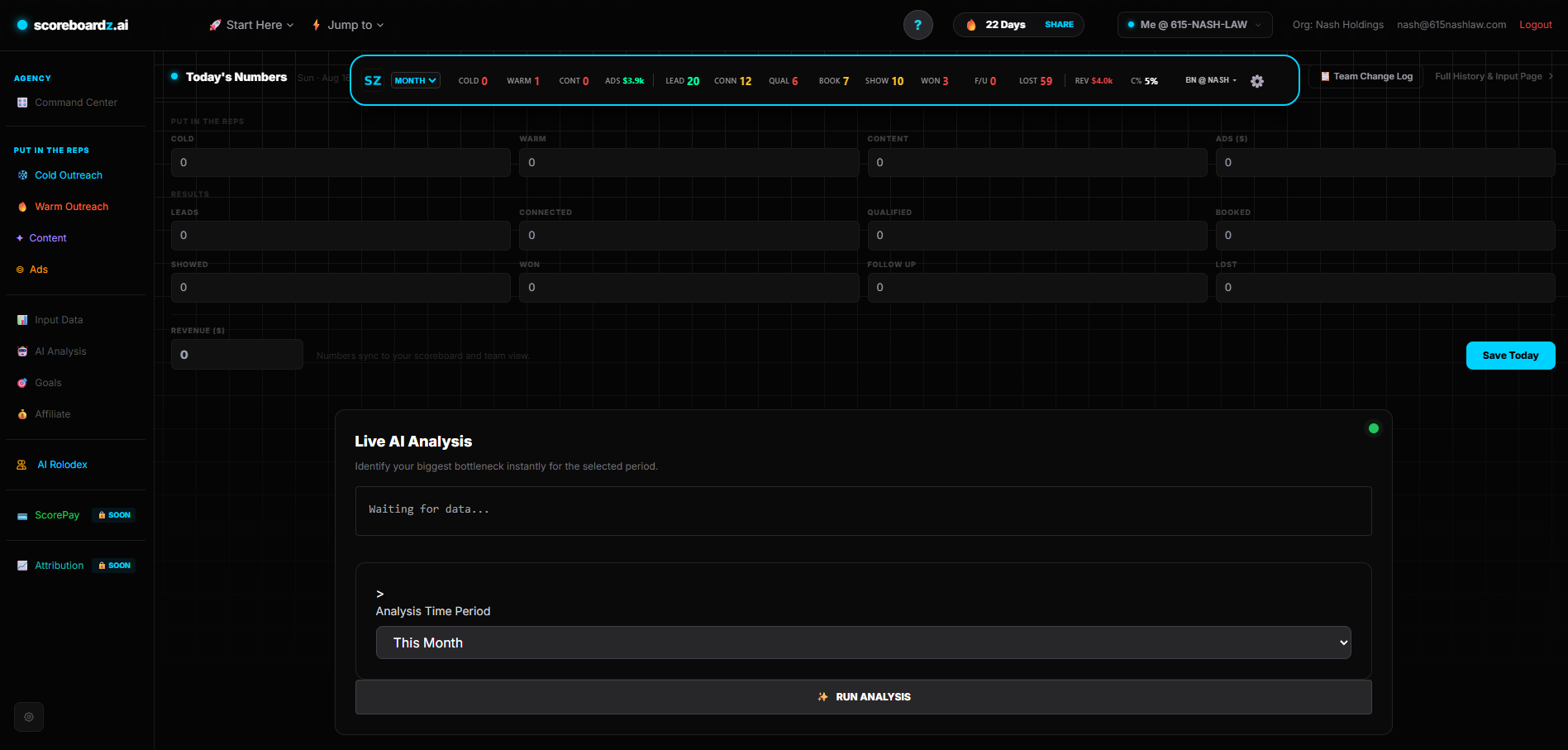
So I built the Scoreboardz floating desktop toolbar.
It stays above the applications you're already using and shows key metrics against your goals.
The colors make it easy to understand your pace.
GREEN — On Pace
You're meeting or exceeding your current target.
YELLOW — Needs Attention
You're approaching a point where you may fall behind.
RED — Behind Pace
You're below your target and may need to adjust your activity.
Instead of waiting until Friday to discover you're behind, you can see it while there's still time to act.
Think About What That Changes.
A sales rep starts the morning and sees they're behind on outreach.
They know what needs attention.
A sales manager sees appointments are falling behind target.
They can investigate before the week is over.
A founder sees leads are strong but closed deals are weak.
They can focus on conversion instead of automatically spending more on advertising.
The scoreboard doesn't do the work for you.
It helps you see which work needs to get done.
Stop Managing Sales Reps by Asking for Updates. Start Coaching With Data.
If you're a sales manager, your job isn't just to collect activity reports.
Your job is to help your team perform.
But how much time do you spend asking people what they've done?
"Did you make your calls?"
"Did you follow up?"
"How many appointments did you book?"
"Why is that deal still open?"
Now imagine having a scoreboard showing the activity and outcomes already recorded in the system.
You can spend less time gathering numbers and more time discussing what they mean.
Instead of asking a sales rep how many calls they made, you can discuss why their calls aren't producing appointments.
Instead of asking whether someone followed up, you can review the opportunities still waiting for action.
Instead of relying on gut feelings, you can compare performance against goals and look for coaching opportunities.
The Three Questions Every Sales Manager Should Ask
1. Are we putting in enough reps?
Look at the activity required to create opportunities.
2. Are those reps producing the right outcomes?
Look at connection rates, appointments, attendance, and closed deals.
3. Where are we losing opportunities?
Look at the stages where prospects stop progressing.
The answers help you decide whether to increase activity, improve skills, fix a process, or investigate lead quality.
That's more useful than another meeting built around incomplete reports.
Your Best Salespeople Know the Power of Keeping Score
Think about the most competitive salesperson you've ever worked with.
They probably wanted to know their numbers.
How many deals they've closed.
How close they are to quota.
How they compare with their own goals.
How much more they need to do to win.
Good salespeople often respond to clear targets and timely feedback.
But you can't expect someone to focus on a scoreboard they never see.
That's why Scoreboardz was built around visibility.
It makes the score part of the workday.
Not something buried in a report.
Not something reviewed only during a weekly meeting.
Something your team can keep in front of them while they're putting in the reps.
And when the whole team understands what matters, managers can spend more time helping people improve.
Why I Built Scoreboardz: I Was Running My Own Business Without Knowing the Score
My name is Brian Lee Nash, Esq.
I'm an attorney and the founder of Scoreboardz.
I've spent 16 years running my own law firm in Nashville, Tennessee.
That means I've been responsible for more than practicing law.
I've had to generate leads.
Manage intake.
Hire people.
Train people.
Track expenses.
Close clients.
And figure out how to grow the business.
Like many founders, I had plenty of software.
But I didn't have one simple place showing me the activities that produced revenue.
Then I was watching one of my kids' soccer games.
The scoreboard was covered.
And I remember thinking:
How are these kids supposed to know whether they're winning?
That's when it hit me.
I was running my business the same way.
I had people working.
Marketing running.
Leads coming in.
Deals being closed.
But I didn't have a scoreboard keeping the most important numbers in front of me.
So I built one.
I started with a floating desktop toolbar.
Then I connected the data, added activity tracking, and built dashboards that showed the relationship between inputs and outcomes.
And I started using it in my own business.
Using the system to track a focused outreach effort, my law firm generated an additional $28,000 in booked revenue over 21 days.
That was exciting.
But what mattered even more was what I learned.
I could evaluate the activities behind that revenue.
I could see how much effort was required.
And I could make a better decision about where to focus my time.
The scoreboard didn't replace the work. It helped me see the results of the work.
That's why I decided to make Scoreboardz available to other business owners and sales teams.
This is my firm's historical experience, not a typical customer result or a guarantee. Results depend on your business, market, sales process, and execution.
One Scoreboard for the Owner. Individual Scorecards for the Team.
As a founder or sales leader, you need to see the business as a whole.
But individual sales reps need to understand their own performance.
Scoreboardz provides business and sales rep scorecards so you can evaluate performance at different levels.
For Business Owners
See how your client acquisition activity, pipeline, and revenue compare with your goals.
For Sales Managers
Review team activity and outcomes to identify where coaching or process improvements may be needed.
For Sales Reps
Track the activities and results that contribute to their targets.
For Multi-Team or Multi-Client Operations
The Agency Command Center provides a roll-up view of connected client workspaces, including performance health indicators and historical windows.

Your Sales Team Already Has Enough Software. Scoreboardz Connects the Numbers.
You probably already use some combination of:
- A CRM.
- Email and outreach tools.
- A calendar or appointment system.
- Advertising platforms.
- Spreadsheets.
- Reporting dashboards.
The problem isn't necessarily a lack of software.
It's that important information lives in different places.
And someone has to remember to look at it.
Scoreboardz is designed to work alongside supported systems rather than forcing you to replace everything.
Current supported connections include:
GoHighLevel: Connect supported CRM activity and pipeline data.
Google Ads: Bring advertising spend into your scoreboard.
Google Local Services Ads: Track supported LSA spend.
Stripe: Connect supported revenue information.
Manual Activity Logging: Track cold outreach, warm outreach, content, and other activities that aren't automatically recorded.
You can also use mobile activity logging to record supported activities while away from your desk.
Integration availability and data coverage depend on your setup.
The goal isn't to give you another complicated system. It's to make the important numbers easier to see and act on.
What Happens When Your Sales Team Starts Keeping Score?
Imagine starting the day with everyone knowing the goal.
Your sales reps can see their pace.
Your manager can see where performance needs attention.
And you can review how activity is translating into opportunities and revenue.
You still have to make the calls.
You still have to follow up.
You still have to deliver a compelling offer.
And you still have to close.
But you don't have to operate without a visible score.
Instead of Asking "What Happened Last Month?"
You can ask:
"What do we need to do today to improve this month's results?"
That's a much better question.
And it's the question Scoreboardz is built to help you answer.
How Much Does Scoreboardz Cost for Sales Teams?
We offer two primary software options, depending on whether your business already has a CRM.
Designed for businesses that already have a supported CRM and want a more visible way to track activity, pipeline, and revenue.
Includes the floating desktop toolbar, dashboards, supported integrations, AI analyzer, and guided setup.
Get Scoreboardz →Includes Scoreboardz plus GoHighLevel CRM, pipeline setup, and follow-up automations.
Get Scoreboardz + CRM →Both plans include three users, with additional users available at $49 per month each.
Your monthly plan starts after your first 14 days live. The one-time setup fee is paid at checkout and is covered by our Show-Up Guarantee: do your setup call and log in on at least 10 of your first 14 days. If you don't love it, we refund your setup fee and you never pay monthly.
Want Help Building the System, Not Just Tracking It?
Scoreboardz All-Star provides a premium option with direct coaching, playbooks, and strategy reviews for businesses that want more hands-on help.
See the current pricing page for full terms, features, and availability.
Frequently Asked Questions About Sales Team Scoreboards
What is a sales team scoreboard?
A sales team scoreboard is a visual way to track sales activities, pipeline progress, conversion rates, and revenue against defined goals.
Unlike a traditional sales report that shows what happened last week or last month, a frequently updated scoreboard helps teams see whether they're on pace while they still have time to make adjustments.
Scoreboardz takes this a step further with an always-visible desktop toolbar that keeps your most important sales numbers in front of you throughout the workday.
What's the difference between a CRM and a sales scoreboard?
A CRM helps you manage contacts, conversations, opportunities, and your sales pipeline.
A sales scoreboard helps you understand whether those activities are producing the results you want.
Your CRM stores and manages information. Scoreboardz makes important activities and outcomes visible against your goals.
Your CRM manages the game. Scoreboardz helps you see the score.
Scoreboardz works alongside supported CRMs, so you don't necessarily have to replace the tools your team already uses.
How can I track my sales reps' daily activities?
Start by identifying the activities that contribute to your sales goals.
These might include cold calls, warm outreach, appointments booked, appointments attended, follow-ups, and closed deals.
Scoreboardz combines supported CRM information with manually logged activities, allowing sales reps and managers to review progress against their goals.
The goal isn't to micromanage every minute.
It's to help everyone understand which activities matter and whether those activities are producing results.
How do I know if my sales team is on pace to hit its monthly quota?
Compare your team's actual performance against its monthly goals and the time remaining.
For example, if your team needs 40 closed deals per month but has closed only 10 halfway through the month, you're behind a simple linear pace.
But closed deals alone don't tell the whole story.
You also need to examine qualified leads, appointments booked, show rates, and conversion rates.
Scoreboardz helps you review these numbers together so you can identify where your sales process may need attention.
What sales KPIs should my team track?
The most useful sales KPIs connect activities to business outcomes.
For many teams, these include:
- Cold and warm outreach activity.
- New leads generated.
- Lead qualification rates.
- Connection rates.
- Appointments booked.
- Appointment show rates.
- Deals won and lost.
- Sales conversion rates.
- Revenue generated.
- Progress toward daily, weekly, and monthly goals.
The right combination depends on your sales process.
Don't track numbers just because they're easy to measure. Track the numbers that help your team make better decisions.
Can Scoreboardz track individual sales reps?
Yes.
Scoreboardz includes individual sales rep scorecards that help managers and team members review activity, outcomes, and performance against goals.
This can help managers identify coaching opportunities while giving sales reps greater visibility into their own progress.
Does Scoreboardz automatically track calls and emails?
Scoreboardz can use supported activity data from connected systems and also provides manual activity logging.
The specific activities available for automatic tracking depend on your CRM, integrations, and configuration.
Not every activity is automatically captured.
For activities that aren't connected, sales reps can log their work manually.
Does Scoreboardz work with GoHighLevel?
Yes.
Scoreboardz supports GoHighLevel integrations for supported CRM and pipeline information.
If you're already using GoHighLevel, you may be able to keep your existing setup and add Scoreboardz.
If you don't have a CRM, Scoreboardz also offers a plan that includes GoHighLevel, pipeline setup, and follow-up automations.
Can Scoreboardz help improve sales conversion rates?
Scoreboardz helps you identify where prospects are dropping out of your sales funnel.
For example, you might discover that your team is generating plenty of leads but booking very few appointments.
Or you might see that appointments are being booked, but prospects aren't showing up.
Those patterns can help you decide whether to improve follow-up, qualification, scheduling, or sales conversations.
Scoreboardz doesn't guarantee higher conversion rates. It gives you information you can use to improve your process.
Is Scoreboardz only for large sales teams?
No.
Scoreboardz is designed for founders, small businesses, and growing sales teams that want better visibility into their client acquisition activities and results.
The standard plans include three users, with additional seats available as your team grows.
How much does Scoreboardz cost?
Scoreboardz offers two primary software plans:
Scoreboardz — $297/month + $500 one-time setup
For businesses with an existing supported CRM.
Scoreboardz + CRM — $397/month + $750 one-time setup
Includes GoHighLevel CRM, pipeline setup, and follow-up automations.
Both plans include three users. Additional users cost $49 per month each.
A premium All-Star option is also available for businesses seeking direct coaching and implementation support.
Is the setup fee refundable?
Yes.
Yes, under the Show-Up Guarantee. Do your setup call and log in on at least 10 of your first 14 days live.
If you don't love it, tell us within those 14 days and we'll refund your setup fee. Your monthly plan only starts after your first 14 days live.
Can I talk to someone before purchasing?
Absolutely.
Book a 20-minute discovery call to discuss your sales process, existing tools, and whether Scoreboardz is a fit.
Can I be a guest on Put in the Reps without being a Scoreboardz customer?
Absolutely.
Put in the Reps with Brian Lee Nash, Esq. is a show about the daily activities, systems, lessons, and experiences behind building successful businesses.
I'm interested in talking with founders, sales leaders, and business owners who are putting in the work.
You don't need to purchase Scoreboardz to apply.
You're Already Putting in the Reps. It's Time to Start Keeping Score.
Every day, your sales team is putting in the work.
Making calls.
Sending emails.
Following up.
Booking meetings.
Giving presentations.
Closing deals.
But activity without visibility makes it harder to know whether you're moving in the right direction.
And a CRM full of data doesn't do much good if nobody is looking at the numbers that matter.
That's why I built Scoreboardz.
Not to replace your salespeople.
Not to replace your CRM.
Not to give you another report you have to remember to check.
I built it to help founders, sales managers, and sales reps see the relationship between the work they're doing and the results they're producing.
Because when everyone knows the score, everyone has a better opportunity to improve.
I'm Brian Lee Nash, Esq., founder of Scoreboardz.
I built this system to solve a problem in my own business.
Now I'd love to help you put it to work in yours.
Three Ways to Connect With Scoreboardz
1. Ready to Start Keeping Score?
Explore Scoreboardz plans and choose the option that fits your team.
2. Want to See How Scoreboardz Works With Your Sales Team?
Let's spend 20 minutes discussing your current sales process, CRM, goals, and whether Scoreboardz makes sense for your business.
3. Building a Sales Team? Come on My Show.
I'm always interested in meeting founders and sales leaders who are putting in the work to grow their businesses.
On Put in the Reps with Brian Lee Nash, Esq., we talk about the daily activities, systems, wins, and lessons behind building a successful business.
You don't need to be a Scoreboardz customer.
You don't need a perfect success story.
Just be willing to share what you're building and the reps you're putting in.
Know the Score. Win the Game of Business.
Same Team. Same Outreach. More Visibility.
Scoreboardz is business performance software. Results depend on your sales process, market, team execution, and other factors. Individual outcomes are not guaranteed.